เนื้อหา
- 1. Introduction: Self-analysis to find the root flaws
- 2. วิธีการวิเคราะห์ตนเองอย่างง่ายและรวดเร็ว
- 2.1 เป็นข้อบกพร่องของบุคลิกภาพ หรือเป็นการแสดงออกของอัตตา? (คอลัมน์ G)
- 2.2 ตัวอย่างการวิเคราะห์ตนเองในทางปฏิบัติที่ 1 – การกระทำที่ไม่ถูกต้อง / การไม่ลงมือทำ
- 2.3 Practical Self-Analysis Example 2 – Incorrect Response
- 2.4 Practical Self-Analysis Example 2 – Incorrect Actions (Further Insight)
- 2.5 Filling in the chart
1. Introduction: Self-analysis to find the root flaws
ในบทนี้ (ซึ่งเป็นการต่อเนื่องจากบทก่อนหน้า) จะอธิบายเพิ่มเติมเกี่ยวกับวิธีการกรอกแบบฟอร์ม เครื่องมือวิเคราะห์ตนเอง หรือที่เรียกว่า แผนภูมิ PDR ในบทก่อนหน้า เราได้เน้นถึงการทำความเข้าใจระดับความรุนแรงและผลกระทบของความผิดพลาดส่วนในบทนี้ จะอธิบายถึงวิธีการวิเคราะห์หาสาเหตุรากเหง้าของการกระทำหรือการตอบสนองที่ไม่ถูกต้อง
2. วิธีการวิเคราะห์ตนเองอย่างง่ายและรวดเร็ว
ครั้งต่อไปที่คุณสังเกตว่าตนเองทำผิด หรือมีผู้อื่นชี้ให้เห็นความผิดของคุณ นั่นคือโอกาสอันดีสำหรับการใคร่ครวญภายใน และการวิเคราะห์ตนเอง เพื่อเพิ่มระดับของการตระหนักรู้ในตนเอง ความผิดพลาดนั้นอาจเล็กน้อยหรือรุนแรง แต่ไม่ว่าจะเป็นแบบใดก็ตาม ล้วนเป็นโอกาสในการเข้าใจจิตใจของตนเองให้ลึกซึ้งยิ่งขึ้น การวิเคราะห์จะมุ่งเน้นไปที่คำถามว่า “ข้อบกพร่องทางบุคลิกภาพของฉันคืออะไร ที่ทำให้เกิดความผิดพลาดนี้ขึ้น?”
เพื่อค้นหาข้อบกพร่องหลักที่เป็นสาเหตุของความผิดพลาด เราจำเป็นต้องตั้งคำถามกับตนเองซ้ำ ๆ ว่าทำไมฉันถึงทำการกระทำนั้นที่ไม่ถูกต้อง? ทำไมฉันถึงมีปฏิกิริยาเช่นนั้น?จากนั้นให้ นทึกผลการวิเคราะห์ของคุณลงใน ช่อง G, H, I และ J ของเครื่องมือวิเคราะห์ตนเอง หรือแบบฟอร์ม PDR Chart ด้านล่างนี้เป็นตัวอย่างบางส่วนของแผนภูมิการวิเคราะห์ตนเองที่ใช้สำหรับบันทึกความผิดพลาดที่เราได้ทำลงไป
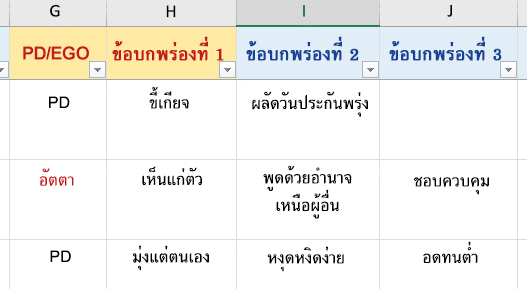
2.1 เป็นข้อบกพร่องของบุคลิกภาพ หรือเป็นการแสดงออกของอัตตา? (คอลัมน์ G)
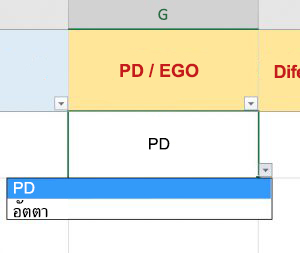
ใน คอลัมน์ G จะมีให้เลือกสองประเภทในการจัดหมวดหมู่ของความผิดพลาด คือเกิดจาก ข้อบกพร่องของบุคลิกภาพ (Personality Defect – PD) หรือเกิดจากอัตตา เมื่อคุณเลือกประเภทใดประเภทหนึ่งในคอลัมน์ G แล้ว ระบบหรือแบบฟอร์มในคอลัมน์ H, I และ J จะปรากฏรายการของข้อบกพร่องของบุคลิกภาพ หรือการแสดงออกของอัตตาที่เกี่ยวข้องให้เลือกเพิ่มเติม
แล้วจะตัดสินได้อย่างไรว่า ความผิดพลาดนั้นเกิดจาก PD หรือ Ego?
แท้จริงแล้ว ข้อบกพร่องของบุคลิกภาพทั้งหมดมีรากเหง้ามาจากอัตตา เพียงแต่ว่า อัตตาเป็นสิ่งที่ฝังลึกกว่า ในขณะที่ PD เป็นเพียงการแสดงออกภายนอกที่ผิวเผินกว่าของอัตตาเท่านั้น ดังนั้น เมื่อจะตัดสินว่าความผิดพลาดนั้นมาจาก PD หรือ Ego ให้ถามตนเองว่าข้อบกพร่องนี้ฝังลึกใน สัยของฉันมากน้อยเพียงใด? ถ้าเป็นกรณีที่เกิดขึ้นเป็นครั้งคราวหรือไม่บ่อยนัก ให้เลือก PD (Personality Defect) แต่ถ้าเป็นลักษณะนิสัยที่เห็นชัดและเกิดขึ้นซ้ำ ๆ อย่างต่อเนื่อง ให้เลือกอัตตา สามารถอ้างอิงจากตารางหรือแผ่นงานที่แสดงรายการของ personality defects และ ego points ซึ่งจัดทำไว้เป็นแนวทางในการช่วยจำแนกประเภทของความผิดพลาดได้อย่างถูกต้อง
ขั้นตอนต่อไปคือการกรอกคอลัมน์ H, I และ J หลังจากที่ได้ทำความเข้าใจหรือวิเคราะห์แล้วว่าข้อบกพร่องของบุคลิกภาพ หรือจุดของอัตตาใดบ้างที่มีส่วนทำให้เกิดความผิดพลาดนั้นขึ้น
ในหัวข้อ 2.2 ถึง 2.6 ต่อไปนี้ จะอธิบายอย่างละเอียดถึงวิธีการทำการวิเคราะห์ตนเองอย่างเป็นขั้นตอน เพื่อให้สามารถกรอกแบบฟอร์ม PDR Chart ได้อย่างถูกต้อง
2.2 ตัวอย่างการวิเคราะห์ตนเองในทางปฏิบัติที่ 1 – การกระทำที่ไม่ถูกต้อง / การไม่ลงมือทำ

ตัวอย่าง สมมติว่าคุณสังเกตเห็นความผิดพลาดของตนเองว่า – “ฉันไม่ได้ล้างแก้วกาแฟหลังจากดื่มกาแฟเสร็จ”
This is an example of not doing what you should be doing. To help you do a deeper self-analysis of this action, ask yourself, “Why didn’t I wash my coffee cup?”
There can be many different answers, each reflecting a different root cause of the failure. The analysis will depend on what was the main thought in your mind at the time that was behind the inaction. The following table provides an example of how a root cause analysis can be performed.
| The idea behind the mistake | The idea behind the mistake |
|---|---|
| I don’t wash coffee cups because I feel it’s beneath my dignity. My time should be spent on more important things, like working on the computer, while my wife can do these housework. | Pride |
| I intended to wash the coffee cups, but there were too many things to do. After that, I forgot about it and didn’t do it. | Lack of planning and organization or being disorganized |
| I don’t want to do it now. I think I’ll do it later. I just want to lie on the couch and relax. | Laziness |
| I’ve already done a lot of housework. Family members should help wash the coffee cups. | Too much expectation of others |
As you can see, in each case, the errors to fill in columns H, I, and J depend on the idea behind not washing the coffee cup.
2.3 Practical Self-Analysis Example 2 – Incorrect Response
In this section, we will study an example of incorrect response analysis.

Joan noticed her own reaction: “I felt angry at my manager when he complimented my coworker (Tina) instead of me.”
To begin the process of self-analysis, Joan needed to ask herself, “Why did I feel angry when my manager complimented Tina?”
Depending on which thought triggers the anger, Joan will be able to assess which personality flaw is the primary cause of the reaction.
| The idea behind the angry reaction | Root personality flaws |
|---|---|
| My boss only praises Tina, never seeing my efforts. No matter how hard I try, no one appreciates it. | Jealousy |
| At my last job, no one praised me. Even at home, no one appreciated my efforts. Am I not good enough? | Self-insecurity |
| My boss is biased. I even do a better job than Tina. | bias |
| I’m going to embarrass Tina because I think she’s not as good as everyone thinks. | Anger and vengeance |
2.4 Practical Self-Analysis Example 2 – Incorrect Actions (Further Insight)
In some cases, we may need to question ourselves several times to dig deeper into the root of the personality flaw that is causing the wrong action or response.
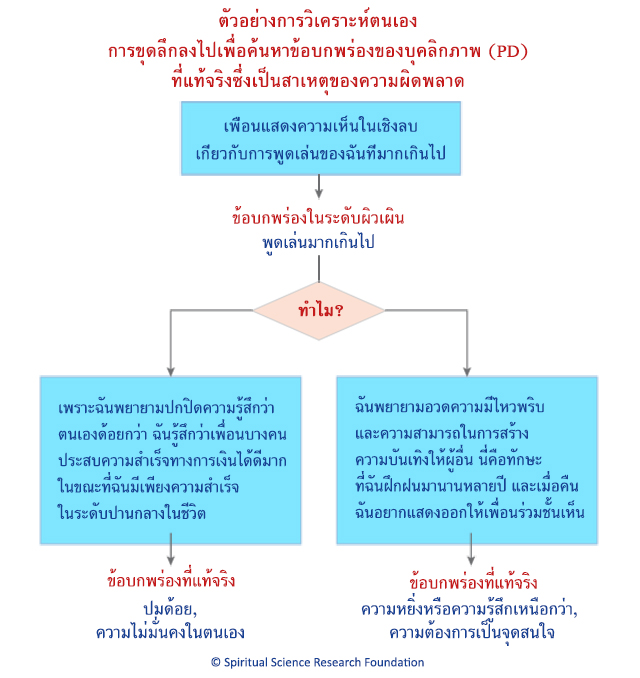
Incident : I joked too much when I met an old school friend at a reunion after not seeing him for many years. Some of my friends made negative comments about my excessive jokes.
(Note: Having a sense of humor or joking isn’t inherently bad, but too much joking can be annoying. Therefore, joking too much is a mistake that, if we analyze ourselves more deeply, may reveal something deeper within ourselves. So, when doing self-analysis, we should ask ourselves, “Why do I joke too much?” and ask the same “why” several times to understand the real reason or motivation behind the action. Each “why” answered brings us closer to the root of the flaw.
2.5 Filling in the chart
It is important to note that sometimes a single fault may be caused by a combination of personality faults, not just one. For this reason, the PDR Chart form has three boxes (H, I, and J) to indicate the fault or expression of the relevant ego. Column H: indicates the primary fault. Columns I and J: indicates the fault or expression of the secondary ego.
Example: In the case of the error “I feel lazy, I don’t want to do the dishes after dinner,” the primary personality flaw is laziness, and a secondary flaw that may contribute to this error is procrastination. Therefore, after selecting PD in Column G for this error, enter Fault 1 (Column H) as “Lazy” and Fault 2 (Column I) as “Procrastination.” If no other flaws can be specified, Fault 3 (Column J) can be left blank. However, it is most important and essential to always enter at least one flaw for each error.